


How much does it cost to charter an aircraft for a group? What affects the price of a charter?
How much does it cost to charter a passenger aircraft? This question usually arises at the very beginning of planning travel logistics for dozens or hundreds of people. To assess whether a charter fits the event budget, it is important to understand one fundamental difference between a scheduled and a private flight: with an ad hoc charter, you do not buy individual ‘per-seat’ tickets. You charter the entire aircraft, the crew’s time and the complete operational infrastructure. Calculating the cost of chartering an aircraft such as a Boeing 737 is an analytical process in which the price is always tailored to the brief. What exactly affects the final quotation and how can you optimise a group-trip budget wisely? Let us break the ad hoc charter process down into its key components.
Contents
- What determines the price of chartering a passenger aircraft?
- Aircraft charter versus scheduled flights: calculating hidden costs
- The direct model: why does the absence of a broker reduce costs?
- How should you submit an enquiry to receive an accurate quotation?
How much does it cost to charter an aircraft? Parameters that affect the price of a charter
Calculating an ad hoc flight is like building a complex logistics project. The final amount on the invoice consists of several key operational variables. What really shapes the price of chartering an entire passenger aircraft?
- Route, distance and flight time: range translates directly into aviation-fuel consumption, which is the largest cost component. A short European flight to popular airports is priced differently from a route to smaller local airports. With Boeing 737-family aircraft, short- and medium-haul flights of up to around 6.5 hours are operated non-stop. Longer routes require a technical refuelling stop and individual analysis.
- Airport and navigation charges: every airport has its own tariff for landing, parking, passenger services and ground handling. Choosing a principal transport hub in high season, for example July and August, is often more expensive than landing at a smaller regional airport, which may also be much closer to the final destination. An aircraft-charter enquiry submitted well in advance usually provides more options, although urgent ad hoc requests can also be handled. In that case, it is crucial to send complete information quickly: origin, destination, dates, passenger count, one-way or return travel, and baggage requirements.
- Aircraft rotation and parking: the flight schedule has a major impact on the final quotation. If a group flies to a one-day event and returns the same evening, the aircraft simply waits on the apron, generating parking costs. For multi-day trips, the aircraft often has to return empty to base, known as an empty leg, or operate another rotation; this requires the operating costs to be calculated twice. The aircraft, crew and operational plan must be arranged so that the flight is feasible, safe and compliant. Sometimes a different timetable or returning the next day is less expensive, but this can only be assessed after the precise route has been checked.
- Seasonality and crew availability: aviation is governed by strict rules on the maximum working time of pilots and cabin crew. Flights at the peak of the season, or those requiring additional crew because of complex rotations, are priced differently from operations in quieter months.
- Special baggage and cargo: standard passenger baggage is included in the cost; however, transporting pallets of event equipment, musical instruments or oversized sports equipment requires dedicated loading planning and specialist ground handling. Sports clubs may need to consider equipment, event productions technical elements, and companies catering, branded headrests, transfers, accommodation or an on-site programme. Additional services are not mandatory, but they genuinely affect the cost of the whole trip.
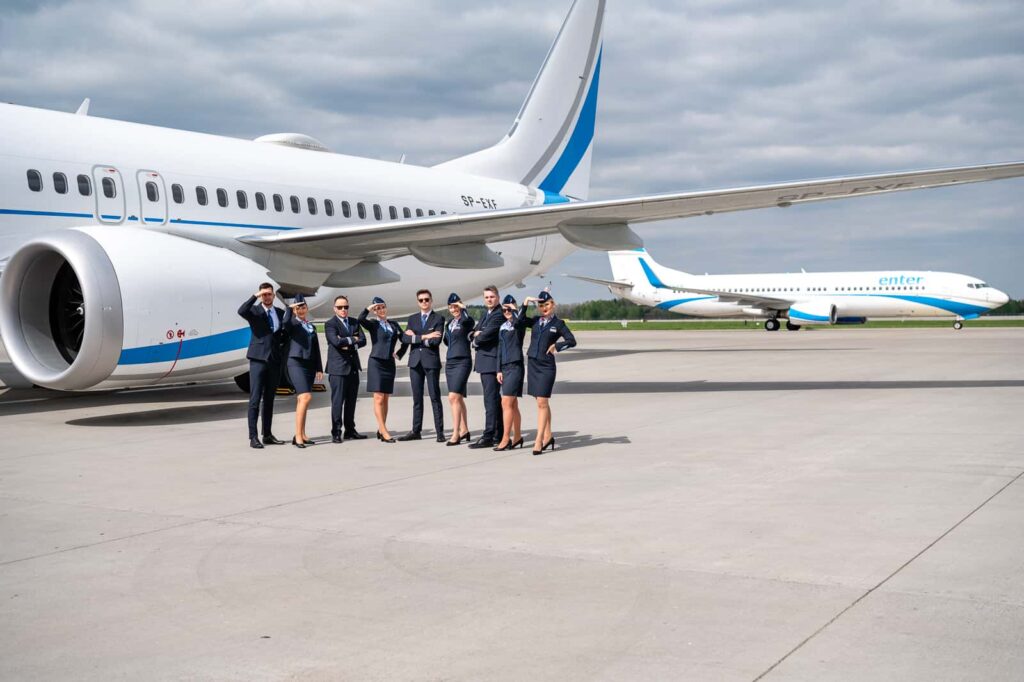
When booking an ad hoc flight, the client is not buying merely a seat on an aircraft, but an entire tailor-made service. This is the essential difference from a scheduled ticket, which is part of a standard timetable and a pre-defined airline product. With an on-demand charter, you receive not only the flight itself but also the organisation of the flight operation, flexible timings, airport selection, ground handling and often additional elements tailored to the group’s or business’s needs. Therefore, when comparing the price of an entire aircraft with a ticket price, consider not only the flight itself, but also the scope of service, the degree of control over the date and route, and the added value of full personalisation.
Aircraft charter versus scheduled flights: calculating hidden costs
Wondering what chartering an aircraft really costs? Comparing the price of a charter with the purchase price of low-cost-airline tickets can be very misleading. For large-group logistics, such as corporate groups, film productions and sports clubs, the total cost of the trip should be analysed: TCO, or Total Cost of Ownership.
When does chartering an aircraft become less expensive and more rational than a scheduled flight?
- Eliminating additional hotel nights: a charter is aligned with the event schedule. It can avoid paying for an extra hotel night for dozens of people, which is often necessary when scheduled flight times are unfavourable.
- Reducing transfer costs: a scheduled aircraft lands where the route network operates, whereas a charter can often be directed to an airport closer to the destination, including a regional airport. This reduces travel time, the number of coaches or minibuses and the risk of logistical delays, which has measurable operational value for large teams.
- No risk of splitting the group: for 100–150 travellers, or more, even one cancelled scheduled flight, overbooking incident or division of the group across several services can create organisational chaos and extra costs that are difficult to recover. A charter provides one rotation, one timetable and one check-in, reducing the risk that some participants arrive later or on a different flight.
Case study: Imagine a company sending 120 employees and partners to a four-day Mobile World Congress conference in Barcelona. The scheduled alternative appears cheaper per ticket, but once the night before departure, an additional hotel night after the event, coach transfers from a large airport and the risk of splitting the group are added, the total cost begins to rise faster than ticket prices alone suggest. With a charter, the whole group flies on one aircraft at a time matched to the event programme. In practice, this eliminates some hidden costs: it shortens time spent travelling, reduces the number of transfers and lowers the risk that some participants arrive late or on another service. For groups of 80–150 people, this synchronisation has real operational value because it simplifies the logistics of the entire trip in one move.
See: A flight for a corporate trip — from enquiry to check-in
The direct model: why does the absence of a broker reduce the cost of chartering an aircraft?
A key part of optimising an aircraft-charter budget is choosing the operator. Enter Charter works in a direct model. This means bypassing the network of intermediaries, or aviation brokers, and contracting directly with the airline that physically owns the fleet.
The absence of a broker commission means not only a lower final price, but above all a radically shorter flow of information. Aircraft-availability checks, operational analyses and decisions on flight feasibility are made immediately by the airline’s experts.
When you submit an enquiry, you do not have to wait for a broker to circulate it to many airlines, collect and compare replies. Our experts have continual, direct visibility of the entire Boeing 737 fleet, so decisions on aircraft availability are made in real time.
In an intermediary model, every non-standard question, for example about carrying large equipment, changing on-board catering or landing at a small airport, has to pass from the broker to the airline and back. With us, you speak directly to the ad hoc flight operations department. This shortens response time from many days to just a few hours or minutes.
Group trips can be dynamic: names may change at short notice or a conference may be extended. With direct contact with the airline, you can be confident that any amendments shortly before departure are implemented immediately, without waiting for third-party authorisation.
By choosing an ad hoc flight directly from the airline, you gain not only the lowest available price, but above all full control over the project’s logistical security.

How should you submit an enquiry to receive an accurate quotation?
Calculating an ad hoc flight is a precise logistics process. For aviation analysts to prepare a firm and realistic aircraft-charter offer, rather than only broad indicative price ranges, the enquiry should include several key operational parameters:
- Cities or preferred airports of departure and arrival.
- Travel dates and preferred time windows. If the trip timetable, for example the start of a conference or match, imposes a fixed time frame, provide the boundary departure or arrival times, for example ‘we must be on site before 12:00’.
- Number of passengers.
- An outline of baggage requirements, for example ‘hand baggage only’, or whether checked baggage is required, such as ‘100 checked suitcases plus technical equipment’.
- Information about the desired standard of additional services: VIP catering, dedicated on-board branding, ground transfers and accommodation arranged by Nekera.
You will find all the key elements in the Enter Charter contact form.
It is also worth defining the trip’s main priority. Sometimes the overriding goal is minimising the budget absolutely; then the analyst will suggest lower-cost airports or the most economical aircraft-rotation times, which can reduce apron parking costs. If, on the other hand, image, privacy, punctuality and full control over logistics are more important, a charter performs a completely different role. It is no longer only a means of transport, but a tool for managing time, risk and the traveller experience, or Brand Experience. In this scenario, a higher cost may be entirely rational because it is offset by time saved, the absence of organisational compromises and the ability to arrive exactly when the event programme requires.
A flight correctly costed and organised directly with the airline becomes the most effective logistics tool for modern organisations, MICE and incentive agencies, and professional sport or entertainment.
If you are planning an aircraft charter for a company, a flight for a sports team or transport for a production crew, compare the total cost. A scheduled ticket can be only one part of the expense. An ad hoc charter provides privacy, shared space, flexible times and airports closer to the destination. That is why, for many projects, chartering an aircraft is not only more comfortable but also organisationally more rational.
Send an enquiry to charter a Boeing 737 or call +48 512 544 556 24/7 at +48 512 544 556. Enter Charter experts are available 24/7.
